
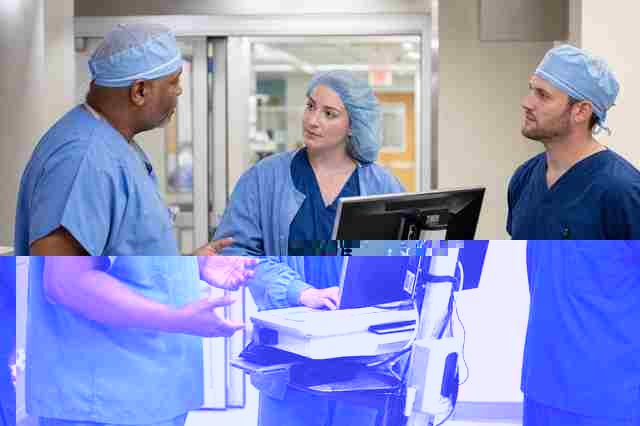
A student shadows one Tuesday and sees three people in blue: one is opening pans, one is on the computer, one is holding a retractor and talking to the surgeon like a peer. The student goes home and Googles “OR jobs,” and the internet hands back surgical tech, circulating nurse, RNFA, CFA, first assist, “OR technician,” and a travel posting that wants a “scrub nurse” who might be an RN or a CST depending on which hospital wrote it.
People pick the wrong school because the titles are a mess. Then they spend two years and a pile of tuition becoming something they do not actually want to do at 6:30 a.m. with a grumpy surgeon and a late add-on.
This is a map of the three roles you keep seeing in job posts — surgical technologist, circulating nurse, and first assist — and how to choose without dunking on anybody. All three jobs are real. They are not the same job with different pay.
The room has jobs that look similar from the door
From the gallery, everyone is “helping the surgeon.” From the field, the work splits.
The surgical technologist is usually the person in gown and gloves at the field: setting up, passing, watching the mayo, protecting sterile, counting with the circulator, and keeping the case moving. In a lot of hospitals that person is a CST. In some it is an on-the-job trained tech. In a few older cultures it is still an RN who scrubs.
The circulating nurse is usually the person not scrubbed: assessing the patient, checking consent, positioning with the team, running the chart, opening extra supplies, calling the blood bank, managing the room’s traffic, and being the licensed nurse of record for that patient during the case. When something goes sideways — airway, allergy, missing implant, family in the waiting room — the circulator is the one who leaves the field and makes the hospital work.
The first assist is doing a different layer of the operation: retraction that requires judgment, hemostasis, suturing, closing, harvesting, camera driving on a robot, whatever that surgeon and that hospital credential the person to do. A first assist might be an RNFA, a CSA/CFA, a PA, an NPP, or a surgeon in training. A tech who “holds a retractor when asked” is not automatically a first assist. Credentialing is the line, not the fact that you have strong shoulders.
Those three people can be excellent in the same room and still be solving different problems.
Why job postings blur the titles
Hospitals copy old templates. A manager who has been there 20 years still types “scrub nurse” when they mean CST. A recruiter who staffs med-surg and OR from the same desk writes “OR tech / nurse” because the ATS has one box. Travel companies use “surgical technician” and “scrub tech” and “OR tech” interchangeably, then hide “RN required” in sentence four.
Rural hospitals blur on purpose. They need one body who can scrub, pull SPD, and maybe circulate under a creative staffing plan. Academic centers blur the other way: they have CSTs, RN scrub, residents, and an RNFA on the same service, and the posting still says “surgical services.”
Read the credentials line, not the job title. If it requires an RN license, it is a nurse job even if the title says technician. If it requires CST and says “no RN license required,” it is a tech job even if an older nurse on that team still scrubs. If it requires RNFA or CFA/CSA and first-assist privileging, it is an assist job, not a standard tech posting.
If the posting cannot decide, email and ask: “Is this a CST scrub role, an RN circulator role, or a first-assist role? Which credential is required to start?” One sentence. You will get a clearer answer than the paragraph they posted.
What the work feels like day to day
Surgical technologist
You live in the setup and the field. Your brain is instruments, sequence, counts, and the surgeon’s habits. A good day is a list that runs on time because you anticipated the conversion from laparoscopic to open and already had the tray. A bad day is a missing implant, a broken lock on a needle driver, and a count that is off while the attending is staring at you.
You are close to the operation and far from the rest of the hospital. You do not usually call the floor, start the IV, or explain the consent. You also do not usually get the same formal authority when a surgeon is being unsafe with the field. You speak up anyway — that is the job — but the power structure is different from the nurse’s.
Education is typically a 12–24 month program plus CST in hospitals that require it. Pay sits below RN circulator pay in most markets, sometimes by a lot, sometimes by a smaller gap once you add call and nights. The ceiling as a tech is real: charge tech, preceptor, educator, SPD leadership, first-assist pathway if you add school and privileging, or leaving for industry.
Circulating nurse
You live in the whole patient and the whole building. You might scrub on some teams. Many circulators barely scrub after orientation. Your stress is different: the difficult airway in holding, the consent that does not match the site, the family that did not hear “possible stoma,” the implant that is not on the shelf, the blood that is not in the room, the student who is about to break sterile.
You need an RN license. That means nursing school, NCLEX, and a hospital that will train you in the OR if you did not come from a perioperative program. Peri-op internships exist. So does being thrown into the room with a preceptor and a prayer. Ask which one you are walking into.
Pay is usually higher than CST pay in the same building, plus RN differentials in some systems. You can leave the OR and still be a nurse. That mobility is the part students underestimate when they only look at the first hourly rate.
The cost is school length, debt, and a job that includes nursing chores techs do not do: meds, documentation load, and being the license the hospital hangs the case on.
First assist
You are in the operation as an extra pair of trained hands, not as the person running the mayo. Surgeons notice if you are good. They also notice if you are guessing. The work can be physically harder (retraction, stance, hours at a robot console) and politically harder (you are in the surgeon’s personal space, and some of them are territorial).
Paths vary. RN to RNFA. CST to CSFA (or equivalent assist credential) plus hospital privileging. PA school. None of those paths is a weekend course and a raise. Hospitals credential first assists individually. A card in your wallet does not mean you can close on Dr. Patel’s hernias next Monday.
Pay can beat staff CST pay, sometimes by a wide margin on busy services or in surgeon-employed models. It can also be “tech pay plus a little” if the hospital treats assist as extra duty. Read the offer. Ask who employs you — hospital or surgeon group — and who pays malpractice and call.
Pay and education are a tradeoff, not a ranking
Students ask which job “is better.” Better at what.
If you want to be in the field, hate nursing school, and want to work in about a year, surgical tech is the honest path. You will hit a pay ceiling. You will explain your job at every family barbecue. You will also be employable in a lot of ORs if you get certified and stay current.
If you want license mobility, higher typical pay, and a way out of the OR later, nursing is the honest path. You will spend longer in school. You may circulate more than you scrub. If your fantasy was “I just want to pass instruments,” you may be annoyed by the charting.
If you want to operate at a higher level and you already like anatomy and surgeons, first assist can be worth the extra school — after you have been in the room long enough to know you can stand there for a career. Going straight at assist credentials with almost no OR time is how people burn money.
Approximate education time people actually live:
- Surgical tech program: about 1–2 years, then CST if required
- RN: 2–4 years depending on ADN vs BSN, then NCLEX, then OR training
- First assist: RNFA or CSFA (or similar) on top of the base credential, plus privileging that can take months
Approximate pay in many hospitals, not a promise: staff CST hourly is often below staff RN OR hourly in the same building. Assist pay is all over the map. Travel rates scramble all of this and should not be your baseline for a life decision.
Do not pick a path from a TikTok that says “techs make what nurses make on call.” Call pay is real. It is not a career plan.
When a tech should go back to school for RN — and when that is a bad use of years
Go toward RN if most of these are true:
- You keep hitting a wage scale that will not move
- You want to leave the field some days and still have a job
- You are willing to circulate, medicate, and own the chart
- You have a realistic school plan (evenings, employer tuition, or savings) that will not wreck your family
- You have shadowed a circulator for more than one easy laparoscopic day
Stay a tech, or go toward assist, if most of these are true:
- You love the field and tolerate the rest
- Nursing school would be a four-year detour you resent
- Your hospital will pay you fairly on nights, call, or a specialty
- You want CSFA or a similar assist path and the surgeons you work with will actually privilege you
- You are considering RN only because someone said techs are “not real medical”
That last one is a poor reason to take on nursing school debt. Respect is not a degree plan.
A hybrid that works for some people: stay CST, work, use tuition assistance for ADN/BSN part-time, then bid for circulator or stay scrub as an RN if that culture exists. A hybrid that fails: quit a decent tech job, rush an RN program, and discover you miss the mayo and hate Meditech.
If you are trying to decide, spend two shifts: one scrubbed with a strong CST, one circulating with a strong RN. Take notes on when you were bored, when you were scared, and when you felt useful. That notebook is worth more than a career quiz.
How the three roles actually work together
The rooms that feel good have a boring quality: people stay in their lane and still cover each other.
The tech does not need the nurse to pass every tie. The nurse does not need the tech to “just open whatever.” The assist does not treat the tech like a silent tray robot. Counts are a shared ritual, not a power play. When the implant is wrong, nobody spends ten minutes deciding whose fault it is while the patient is open.
Conflict usually starts in three places:
- Who is in charge of the field. The surgeon is in charge of the operation. The circulator is in charge of the nursing process and a lot of the room’s safety net. The tech is in charge of the sterile setup and the instrument plan. Those can overlap. Adults negotiate. Children score points.
- Who gets overtime and who gets sent home. This is a staffing problem dressed up as a personality problem.
- Who the surgeon likes. Favoritism is real. It is also a bad compass for your career. Build a reputation with the charge nurse and the educator, not only with one attending.
If you are a student, watch how people talk when a count is off. That moment tells you more about a department than the tour.
How to read a posting without picking the wrong school
Before you enroll in anything, collect five local postings and line up the required credential.
- CST or “surgical technologist” + no RN license → tech program
- RN + BLS + “circulates and scrubs” → nursing, then peri-op
- RNFA / CFA / CSA / first assist + privileging → extra credential on top of RN or CST, depending on the card they name
If your town only hires RN scrub and does not hire CSTs, that is local market reality. Do not fight it with a tech diploma and hope. If your town is CST-heavy and RNs mostly circulate, a tech program is not a lesser choice. It is the job they actually staff.
Talk to working people, not only admissions staff. Admissions gets paid when you start. A CST on nights will tell you if grads are getting jobs.
You can browse role-specific postings on surgicaltechjobs.pro when you want to see how hospitals are writing CST vs circulator vs assist this month. Use live ads as market research before you sign a student loan.
Your next move before you apply to a program
Shadow one full day in each role if the hospital will let you. Write down the parts you would still want to do on a Friday in February when the board is a mess. Then look at two years of local job ads and count how many require which credential.
Pick the job you can picture yourself doing, not the title that sounded most medical in a brochure. The room does not care what the brochure called you. It cares whether you showed up able to do the work they hired.
[…] next. The longer version of how scrub, circulator, and assistant sit next to each other is in who does what in the room. Hearts add perfusion. They own the pump. You own the sterile hardware that connects the patient to […]