
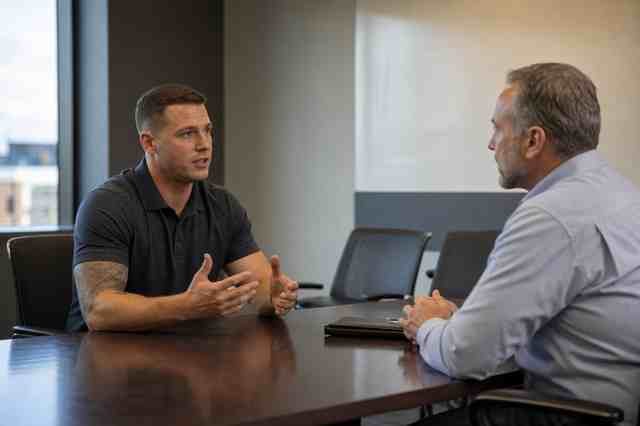
You finished a 12-hour day of cases. You can set up a trauma laparotomy in your sleep, you have run a cysto table with a brand-new resident, and you have held a room together when the circulating nurse was new and the attending was already gowning. Then you apply to a civilian hospital 20 miles from base, and the recruiter emails: “We need two years of hospital OR experience and a current CST. Unfortunately you do not meet the minimums.”
That email is not about your skill. It is about a keyword filter that does not know what 68D, HM surgical tech, or 4N1X1 means. Civilian HR is not being cruel on purpose. They are matching a posting to an ATS, and your DD-214 and service school certificate do not look like “Memorial Hospital, CST, 2021–2024.”
This is the gap that dumps highly trained military techs into sterile processing, travel-company holding tanks, or a year of underemployment while they figure out civilian language. You can close it. You have to do it on paper before you do it in an interview.
What civilian HR actually sees when they open your file
Most civilian OR leadership would hire you after one conversation. Most civilian HR never gets that far.
They see job titles first. “Operating Room Specialist” or “Surgical Service Technician” does not auto-map to “Certified Surgical Technologist” in their system. They see “military hospital” and sometimes assume it is clinic work, not a full OR. They see deployments and PCS moves and read “job hopper.” They see a school that is not the local community college and they do not know whether it was CAAHEP, ABHES, or an internal service program.
They also do not know your case mix. A year in a Role 3 or a busy MTF can mean more trauma, more ortho, and more autonomy than three years in a sleepy community OR. None of that is visible unless you write it in civilian words.
Translate the MOS and rating into a job title they can search
Put the civilian title first, then the military title in parentheses.
Use something like: Surgical Technologist (Army 68D Operating Room Specialist). Or: Surgical Technologist / First Scrub (Navy Hospital Corpsman, Surgical Technology). Or: Surgical Technologist (Air Force 4N1X1 Surgical Service).
Do not lead with the code. The code belongs in one line of the resume and one line of your cover note. If you lead with 68D, a recruiter who has never worked with the military will skip you in eight seconds.
Under that title, write the work the way a civilian manager talks:
- First scrub and second scrub on general, ortho, GYN, ENT, urology, vascular, and trauma (list what you actually did)
- Room setup, counts, sterile field, specimen handling, and turnover
- Call, nights, and weekend coverage if you took it
- Precepting junior techs or corpsmen
- Deployed or field-hospital work, named as such, with case types
If you ran sterilizers, pulled consignment trays, or covered SPD when they were short, put that in a short separate bullet. Civilian hospitals like a tech who understands instrumentation. They do not want to think you are applying for an SPD job by accident.
Write case volume like a civilian resume
Civilian managers ask “what did you scrub?” not “what was your unit.” Give them numbers you can defend.
“First-scrubbed an average of 6–10 cases per shift in a 6-room MTF, mix of general, ortho, and GYN.” That sentence does more than “provided world-class surgical support.”
If your numbers were lower because you were in a smaller facility, say that honestly and emphasize breadth or call. If you were in a high-volume center, say so. Do not invent counts. Approximate ranges are fine if you can talk through them in an interview.
Name procedures they recognize: total joints, laparoscopy, C-section, crani, CABG, cysto, robotics if you touched it. Military shorthand (ex-lap, FASCI, “the trauma table”) needs a civilian translation next to it.
The CST problem is usually the real blocker
Plenty of military programs produce techs who can work circles around a new civilian graduate. Plenty of civilian hospitals still will not badge you without a CST, and some states treat certification or registration as a condition of employment.
If you already sat the NBSTSA exam and passed, say so in the header of the resume: CST, credential number, expiration. If you have not sat it, do not bury that fact. Civilian recruiters assume “surgical tech” means CST unless you tell them otherwise.
Military training and exam eligibility
NBSTSA has a pathway for people who completed military surgical technology training that meets their current eligibility rules. Those rules change. Before you pay for a review course, pull the current military candidate requirements from NBSTSA yourself and match them to your school, your dates, and your documentation.
What you typically need in hand:
- Training certificates and transcripts from the service school
- Proof of clinical hours if they ask for them
- DD-214 or a statement of service if you are still active
- A clean read of whether your program is treated as equivalent to an accredited civilian program for that exam cycle
If your training is older, or you crossed over from a related rating (corpsman who later “got put in the OR”), eligibility can be messier. Do not take a Facebook group’s word for it. Email NBSTSA with your documents and get a yes or a no in writing.
NCCT’s TS-C is a different credential. Some hospitals accept it. Many job postings still say CST only. If you hold TS-C and the posting says CST, you can still apply, but you should say in the first paragraph that you are eligible and scheduled for CST, or that the facility already employs TS-C techs. Do not assume HR knows the difference.
Study like someone who already knows the room
The CST exam is not a test of whether you can scrub. It is a test of whether you can pick the NBSTSA answer. Military techs fail it when they study the way they learned in the service — by doing — and then get tripped by A&P wording, sterilization parameters, and “what is the first thing you do” questions that do not match real-life sequencing.
Give yourself a real review window. Many people need 6–10 weeks of structured study even after years in the room. Use a current review book, question banks, and the official content outline. If your employer or transition office will pay for a course, take the money. If not, a used current-edition book and a question bank is enough if you actually do the questions.
Do not wait until your terminal leave to start paperwork. Exam dates, transcripts, and eligibility letters eat weeks.
Resume language that gets you past the filter
Your resume has one job before the interview: look like the posting.
Mirror their words. If they say “CST,” your header says CST or “CST-eligible, exam scheduled [month].” If they say “first scrub,” you say first scrub. If they say “robotics,” only claim what you did.
Drop the awards block unless an award names a skill they care about (preceptor, safety, process improvement). “Army Achievement Medal” does not help a recruiter who is scanning for joints and call.
Drop the paragraph of military values. Put a four-line summary instead:
Certified (or eligible) surgical technologist with X years first-scrub experience in a military OR. Case mix: list. Comfortable with call, trauma, and teaching junior staff. Seeking a civilian hospital OR role in [city].
Then jobs in reverse chronological order. Each job: civilian title, military title, facility name, city, dates. If the facility has a civilian-recognizable name (Walter Reed, Brooke, Naval Medical Center San Diego), use it. If it is a smaller MTF, add “X-room OR, [service line].”
The “no hospital experience” trap
This is the sentence that makes people furious, and they are right to be furious. You have hospital experience. It was a hospital. It had an OR. You scrubbed cases.
Say it in the resume: “Military treatment facility, inpatient OR, [number] rooms.” Say it in the cover note: “This is hospital OR experience, not clinic or field-only work” — if that is true. If a chunk of your time was tent or shipboard, say that too, and pair it with the MTF time.
Some civilian managers still want “our kind of hospital.” Translation: they want someone who has used their preference cards, their EHR, their vendors, and their union culture. You will not win that argument by getting angry in the application. You win it by getting to a hiring manager.
How:
- Apply, then find the OR educator or a CST on LinkedIn and send a short note: military tech, CST status, case mix, asking for 10 minutes.
- Use veteran hiring events only if an OR manager will be in the room. A general “veterans mixer” rarely moves surgical jobs.
- Target hospitals that already employ veterans. Ask in the interview how many military techs they have precepted. The ones who have a process will tell you. The ones who have never done it will hedge.
If a hospital will not count your years toward the wage scale, that is a separate fight from getting in the door. Get the offer first. Then ask where they placed you on the step system and why military years were excluded. Some will adjust. Some will not. You decide if the orientation and the shift are worth it.
VA, DoD civilian, and private hospitals are not the same first job
A VA medical center is often the cleanest bridge. They understand MOS language. They have veterans in the department. The hiring process is slow and the USAJOBS posting can look like a novel, but your resume will not be a mystery.
DoD civilian (GS) jobs in MTFs are another bridge if you want to stay in a familiar building. Pay bands and posting language are their own project. Read the specialized experience line like a lawyer. If it says “CST required,” it means CST required.
Private and nonprofit community hospitals move faster and often pay more on nights and call. They are also the ones most likely to auto-reject you for “no hospital experience.” Academic centers can go either way: some love military techs for trauma and work ethic, some are rigid about accredited-program-plus-CST and a year of civilian work.
If you need a first civilian job and you are getting nowhere, consider in this order:
- VA or a hospital with a known veteran OR pipeline
- A busy community hospital that says “CST required, new grads considered” — you are not a new grad, but that posting at least has a human reading applications
- A travel company only after you have CST and a story you can tell about civilian documentation, because many travel jobs want recent hospital references in a specific format
- A short contract or per diem at a place that will give you a civilian reference, even if the money is average
Avoid taking an SPD-only job “just to get in” unless you have a written path to the OR and a timeline. Plenty of people get stuck in decontam for a year.
Licenses, state rules, and the paperwork pile
Certification is national. Employment rules are local. Some states register or license surgical techs. Some hospital systems require CST even when the state does not. Some require BLS only. Some want ACLS because their techs circulate in a pinch or work in a heart room.
Before you PCS or separate, make a folder:
- CST or exam eligibility letter
- BLS (American Heart Association card is what most hospitals want)
- Training transcripts
- Shot record and titers — civilian employee health is picky
- Two or three references who will answer a phone, not just sign a counseling form
- A list of procedures and services you can speak to without notes
If a state has a registration process, start it before you apply locally. If you are moving to a state that does not regulate techs, the hospital policy is still the law that matters for that job.
Do not claim you are “licensed” if you are certified. Civilian HR mixes those words up. You should not.
How to talk in the interview without sounding like you are still in the service
They do not need your rank in every sentence. They need to know you will take direction from a circulating nurse, that you will not fight the count process because “we did it differently at the MTF,” and that you can learn their preference cards without rolling your eyes.
Good answers sound like this:
“I first-scrubbed general and ortho in a six-room OR. I am used to residents and attendings who change the plan mid-case. I am not used to your Epic preference cards yet, and I know that will take a few weeks.”
Bad answers sound like this:
“I ran the room. The nurse just charted.” Even if that was true some days, it is the fastest way to lose a civilian manager.
Ask them how they precept military techs. Ask how long orientation is for someone with your case mix. Ask whether military years count on the wage scale. Ask about call from day one. Write down the answers.
If you want a running list of civilian OR postings that actually say CST, call, and service line in plain language, surgicaltechjobs.pro is built for that search. Use it after your resume already speaks civilian, not before.
Your next move this week
Pick one target city. Rewrite the top third of your resume with a civilian title, CST status, and three case-mix bullets. Email NBSTSA or pull your eligibility if the exam is still outstanding. Then apply to five jobs and send two short notes to OR educators or CSTs at those hospitals.
You already have the skill. The civilian market needs the translation. Do the translation on paper first, then go argue for your step on the wage scale after they want you in the room.