
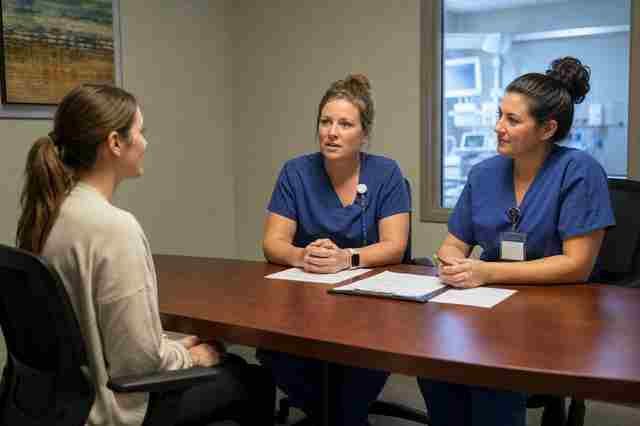
They ask how you would handle a count discrepancy. You recite the textbook chain of command and “the patient comes first.” The educator nods and writes nothing. They were listening for whether you would speak up before the surgeon closes, whether you have actually lived through a missing raytec, and whether you turn into a statue when someone yells. Textbook answers prove you passed school. They do not prove you can scrub.
Surgical tech interviews are short. A recruiter screen, then an educator or charge nurse, sometimes a panel, sometimes a walk through the board. Some departments add a skills test or a shadow. Your job is to sound like someone who has stood in a room, even if you are a new grad whose rooms were clinical.
How they are scoring you (they may not tell you)
They want to know:
- Will you contaminate a field when you are rushed
- Will you count and speak
- Can you take a surgeon’s mood without dumping it on the circulator
- Will you show up for call
- Are you safe enough to leave alone after orientation
- Will you last six months
Every question is a version of those. If you answer with slogans, they have to guess. Give a small, real scene.
“Tell me about yourself” is a skills dump, not a biography
They are not hiring your childhood.
Sixty to ninety seconds:
- What you are (CST/TS-C or new grad, years)
- Where you trained or last worked
- What you first-scrub
- Shift/call you will do
- Why this building (one specific reason: case mix, precepted orientation, commute)
Example shape: “I’m a CST, certified through 2027. I have two years at a community hospital, mostly general, lap, gyn, and ortho sports. I take first call about six shifts a month. I’m looking at your posting because you have a real ortho team and a 12-week orientation. I can start after my notice.”
Stop talking. If they want hobbies they will ask.
Sterile technique scenarios
They will give you a mess: hole in a glove, someone backs into your table, a vendor leans on the field, you notice a strike-through, the surgeon adjusts the light with a dirty handle, a student drops her hands.
They are listening for:
- You notice
- You say it out loud
- You fix it the way that department would want (reglove, redrape, replace the tray, call the circulator)
- You do not shame a student in front of a surgeon if you can correct the field first
- You do not freeze because the person who broke technique has an MD after their name
Answer with a sequence, not a value statement.
“I’d speak up as soon as I saw it. If I contaminated a glove, I’d step back and reglove, or re-gown if that’s what the break needed. If a vendor or observer hit the field, I’d stop the case long enough to fix the field — cover or replace — and I’d get the circulator involved so we are not arguing over the patient. I have done this when a pair of dirty hands reached for a sponge. I said ‘that’s not sterile’ and we replaced. The surgeon was irritated for ten seconds. The field was clean.”
If you are a new grad, use clinical. Do not invent a trauma hero story.
Don’t do: “I would never let the field get contaminated.” Everyone contaminates something eventually. They want the recovery.
Count discrepancy
This is a safety question. They want process and spine.
Walk it:
- Counts happen at the times your department uses (initial, closing, skin, relief)
- You and the circulator own the count together
- If it is off, you say so before the cavity closes
- You recount. You look. You use the protocol: X-ray, search the room, do not fold because someone is late for clinic
- You document. You do not hide a missing needle in a story
Sample answer that sounds like a human:
“If we were off on a lap sponge, I would say ‘we’re off’ before they start closing fascia. We recount, check the bag, check the floor, check the drapes. I would not agree to close because the surgeon is in a hurry. If we still could not find it, we follow the hospital policy — imaging, whatever is written — and I stay in the conversation until it is resolved. I have been in a room where a raytec was on a kick bucket under a drape. The circulator and I were the ones who made everyone pause. That is the job.”
If you have never had a real miss, say so and describe a near-miss or a drill from school. Honesty beats a polished lie.
Difficult surgeon
They are not asking you to trash a name. They are asking if you become dangerous or rude.
They like:
- You keep the field safe
- You do not snap back
- You do not gossip the story in the lounge as your main personality
- You get help from charge or the circulator when it is abuse, not when it is a sharp request for a longer clip applier
“I keep my voice even and I keep passing what they need. If they want it a certain way, I change. If they are yelling because they are scared of bleeding, I stay on the instruments. If it crosses into throwing or personal stuff, I get the circulator and charge involved. I do not argue anatomy with them in the middle of an anastomosis. I have worked with a surgeon who slams instruments. I still counted out loud. I did not slam back.”
Do not say you love everyone. Do not say you would walk out mid-case. Do not name the surgeon from your last hospital.
Call availability and the schedule questions
If the job has call, this is the real interview.
They ask: Are you available for call? Nights? Weekends? Holidays? Can you be here in 30 minutes?
Answer with your actual life. If you live 55 minutes away, do not promise 30. If you have custody every other weekend, say what you can do and what you cannot. They will find out when you start declining.
“I can take the posted call rotation. I live 20 minutes away. I need my already-scheduled week of [date] off, which I put on the application. I cannot do unlimited extra call on top of a 1.0 plus first call, but I can work the rotation as written.”
If you will not take call and the job is built on it, do not take the interview to practice lying. You will be miserable and they will be short.
Overtime: “I understand cases run. I can stay to finish a room I started. I need as much notice as you can give for extra shifts because of [childcare / second job]. I am not going to pretend I can be the everyday mandatory OT person if that is the culture.”
They may still want the everyday OT person. Better to know.
“Tell me about a time” — pick OR stories
Behavioral questions will be some mix of conflict, mistake, teamwork, a time you were overwhelmed, a time you taught someone.
Use a tight story: situation, what you did with your hands and your mouth, result, what you changed.
Good topics:
- A setup you got wrong and how you recovered before incision
- A student or new tech you helped without taking over the whole Mayo
- A late add-on when you were already tired
- A preference card that was wrong
- A time you asked for help instead of hiding
Bad topics:
- A fight with a manager that you still have not let go
- Anything that ends with “so I was right and they were incompetent”
- HIPAA-breaking detail
- A story where you ignored a count to be a hero
New grads: clinical stories count. “In my ortho rotation the vendor opened the wrong implant size and I caught it on the box” is a real story.
Skills checklist, shadow, and the hands-on test
Some places send a checklist in advance. Fill it honestly. “Independent / needs review / no experience” is a map for orientation, not a morality test. If you mark independent on everything, they will put you in a room that will expose you.
Skills tests vary:
- Instrument identification
- Gown and glove
- Set up a basic Mayo / back table from a card
- Questions on sterilization indicators, flash/IUSS rules as that hospital writes them, isolation
- A mock count
They are watching your hands, your pace, and whether you talk through what you are doing. Slow and clean beats fast and sloppy. If you do not know an instrument, say the category and what you would do: “I don’t know that name. I’d ask before I passed a guess.”
Shadow days: they are interviewing you in the hall. Be on time. Do not live on your phone. Ask where to stand. Help turn over if they let you. Thank the tech who was trying to do a list with a stranger in the room.
If they have you scrub on a shadow, treat it like a working interview. Do not narrate every thought. Do not correct their routine out loud unless safety is involved.
Questions you should ask (this is how you avoid a bad unit)
If you do not ask, you are applying to a vibe.
Ask the educator or charge:
- How long is orientation, and who precepts? Are preceptors on the same shift?
- How many techs are budgeted vs how many are actually here on a Tuesday?
- Specialty teams or full float?
- Call: how many shifts a month for a new person, first vs second, trauma vs service?
- Overtime: voluntary or mandatory? Low census rules?
- How do you handle late-running rooms and childcare?
- What does a successful tech look like at 90 days here?
- Why is this position open? (listen for “we cannot keep people”)
- For new grads: how many new people have you kept in the last year?
- Equipment and vendors: will I get in-service on the systems I have not used?
Ask a staff tech if you can, privately:
- Would you take this job again?
- Who is actually in charge of the board?
- How do they treat travelers and new people?
If they bristle at questions about staffing, believe that.
You can mention you saw the posting on a board such as surgicaltechjobs.pro; it does not impress anyone. Your questions about orientation and call will.
Small habits that change the room
- Bring a copy of your resume, cert cards, BLS, and a skills list
- Wear something you can walk the OR in if they tour
- Know the job’s shift from the posting
- Do not badmouth your last charge nurse
- Do not say you just want to get your foot in and move to PA school in a year unless they ask about goals and you can say it without sounding like you will leave in six months
- Send a short thank-you to the person who actually interviewed you, with one specific detail from the conversation
If you freeze, buy a second of time: “Let me give you a real example instead of a generic answer.” Then give the example. Silence while you think is better than a paragraph of quality-care language.
Next action before the interview
Write four stories on paper: a technique break, a count or near-count, a difficult personality, and a time you were behind and still safe. Say them out loud once, like you are talking to a preceptor at the desk, not like you are reading a script. Then write three questions about orientation, call, and staffing. Walk in to prove you can scrub, not to prove you can memorize a definition.