
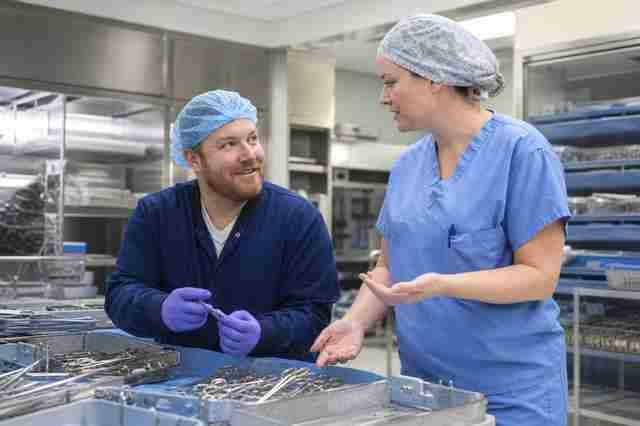
A recruiter tells you there is a sterile processing opening and “a lot of people use it to get into the OR.” You take it. A year later you know every tray in the shop, your back hurts from the washers, and the OR still will not interview you because you are not a CST and you have never stood at a field. Or you go the other way: you finish surgical tech school, hate the surgeons, and wonder why nobody told you SPD existed as a real career and not a basement punishment.
These are different jobs that share a hallway and a lot of instruments. If you pick one as a secret path to the other, have a plan. If you pick one as the job you will actually do, pick it for the life attached to it — shift, body, people, and how you get paid — not for a title that sounds more medical.
What each job is when nobody is selling it
A surgical tech (often a CST once you pass the exam) scrubs. You set up a sterile field, you count, you anticipate, you stand in a room with a surgeon and a circulator until the case is closed. Your day is cases. Your stress is the field, the clock, and whoever is operating.
A sterile processing tech (CRCST is the common certification, sometimes CIS or other add-ons later) cleans, inspects, assembles, sterilizes, and sends out trays. You live in decontam and assembly. Your stress is the washer that is down, the loaner trays that showed up at 4 p.m., the OR calling because a set is missing a needle driver, and the biological that is still incubating when someone wants to flash.
Both jobs keep surgery running. Only one of them is in the room when the surgeon is yelling. Only one of them is still there at 11 p.m. rebuilding the tray that room just threw in a heap.
A Tuesday that tells the truth
Surgical tech Tuesday: you clock in, look at the board, pull for a lap chole and a hernia, scrub the first case, turn over, eat standing if you eat, take an add-on, maybe stay for a late close. You used your brain the whole time. You also did not sit down.
SPD Tuesday: you start in decontam or you start on the clean side depending on the shift. You have a cart of wet pans, a list of trays the first-case rooms need by 7:15, and a vendor implant tray with no count sheet. You will lift, scan, inspect, wrap or container, and argue — politely or not — with a tech who returned a set with bioburden still in the lumen. You might never see a patient. You will feel every late add-on in your workload.
If one of those Tuesdays sounds like relief and the other sounds like a threat, believe that.
Pay, shifts, and what your week actually looks like
Pay overlaps more than people admit. In many hospitals the starting hourly for SPD and a new surgical tech is not far apart. Experienced CSTs, especially with call and specialty differentials, often pull ahead. Experienced SPD techs who sit in lead, educator, or supervisor roles can pass a staff-level CST who refuses call. Do not treat either number as a law. Ask for the range in that building, plus shift differential, plus whether call exists.
Shifts are a real difference. OR days often start before 7 and run until the board is done. Nights and call are common. Weekend programs exist. SPD usually has more true 3–11 and 11–7 staffing because instruments do not stop at 3 p.m. If you want evenings and you do not want a pager, SPD is often the better match. If you want most weekends off and you can live with 6:30 a.m., the OR might treat you better — unless you are in a trauma center.
Physical work is in both. SPD decontam is wet, hot, loud, and hard on wrists, shoulders, and backs. You push carts, you lift pans, you stand on mats that do not help as much as the poster claims. The OR is standing, retracting, twisting, lead, and the sudden lift of a limp leg. People wreck themselves in both. They wreck themselves faster if they pretend one is “light duty.”
Certification, school, and who will hire you
Surgical tech: many employers want a CAAHEP or ABHES program and the CST (or equivalent) within a set window. Some states register or license. Hospital jobs without school exist, but they are fewer than they used to be, and a lot of them still expect you to sit for the exam.
SPD: a lot of people still get hired with a high school diploma and on-the-job training, then sit for CRCST after a required number of hours. Some departments now want the cert before or soon after hire. The barrier to entry is usually lower. That is why SPD gets used as a “way in.” It is also why SPD gets treated as replaceable if the department is poorly run.
Neither cert is a personality upgrade. CRCST says you can run a department’s process. CST says you can hold a field. Hospitals that respect both will still pay the one that is harder to backfill in that city.
Moving from SPD into the OR
This is the path recruiters love to mention. It works when you treat it like a second career, not a promotion you are owed.
What helps: you already know the trays, you know which sets are always incomplete, you know the difference between a sterilizer printout and a wish, and the OR has seen you as the person who answers the phone without panic. That reputation matters. Charge nurses remember who saved a first case.
What does not automatically happen: they do not send you to scrub school because you assembled a year of containers. You still need a surgical tech program in most systems, or a rare on-the-job scrub trainee slot. Those trainee slots go to people who already work there, who have a clean attendance record, and who have asked more than once without badmouthing SPD.
If SPD is your stepping stone, write the plan down
Give it a timeline. Example: twelve to eighteen months in SPD, CRCST done, nights or evenings so you can take a daytime tech program, then apply to that hospital’s next new-grad cohort. Tell your supervisor you want the OR before you need a letter. Ask if they have tuition help. Ask if you can observe in a room on a scheduled day, not sneak in and “help.”
While you are in SPD, learn the trays for the service you want to scrub. If you want general, know the basic laparoscopy and major sets cold. If you want ortho, learn how those loaners actually flow. The OR interview will test whether you understand instruments or you just ran a scanner.
Do not quit SPD the week class starts unless you can afford it. A lot of people try to work full-time decontam and full-time school and fail both. Drop to part-time if you can. The department would rather keep a part-time assembler than lose you and then get a transfer request they cannot fill.
And do not treat SPD coworkers as extras in your origin story. They will be your supply line when you do get to the OR. The tech who was rude in decontam becomes the tech whose tray is “unavailable” on a busy Thursday. That is not a joke in every shop, but the relationship is real.
Moving from the OR into SPD
This direction is less advertised and sometimes smarter. A CST who is done with call, done with a particular surgeon, or nursing a shoulder can be a strong SPD hire — especially in assembly, education, or lead. You already know how the field uses the set. You can look at a tray and see that the needle drivers are the ones nobody can sew with.
Pay may drop if you lose call and specialty differentials. Shift may improve. Stress changes shape. You trade the surgeon for the production board. Some people sleep again. Some people miss the room within a month.
If you go this way, decide whether you are parking for a year or changing careers. Parking is fine. Just tell yourself the truth so you do not spend three years angry that nobody is “sending you back.” Going back after a long SPD stretch is possible, but your scrub speed will be gone and you may need a refresher or a lower-acuity OR.
Who should not scrub
Not everyone who likes instruments should stand at a field. That is not an insult. It is how you avoid becoming the person who dreads 6:45 a.m. for a decade.
You should think hard about scrubbing if any of this is true and does not get better with orientation:
You cannot take a sharp tone without shutting down or snapping back. Rooms will have both. You do not have to accept abuse, but you do have to keep working while someone is tense.
You freeze when the plan changes. Add-ons, conversions from lap to open, a count that is off — the job is change.
You need to sit on a schedule you control. Elective days can still run late. Trauma and call ignore your dinner.
The sight of blood, bone, or a messy open belly makes you leave the room. School cases are cleaner than a Saturday night.
You want the title more than the standing. CST looks good on a badge. The work is physical and repetitive in a way school does not fully show.
SPD is a better first choice if you like process, inspection, and systems, and you want a hospital job without being the person the surgeon talks to. It is a worse first choice if you only took it because someone said the OR would “pull you up.” They might. They might not. You still have to live the job you have now.
Who should not stay in SPD either
SPD is not the easy job. If you cannot handle repetitive physical work, chemical smells, heat, and being blamed for a missing instrument you never saw, you will hate it. If you need constant novelty, assembly will bore you. If you cannot be exact — filters, chemical indicators, load documentation — you are a risk, not a teammate.
Some people use SPD as a holding pen while they decide on nursing, PA school, or leaving healthcare. That is allowed. Put a date on it. Drift is how you wake up five years later with a cert, a bad back, and no plan.
How to choose without romanticizing either hallway
Ignore the prestige ranking. In a well-run hospital both departments are skilled. In a badly run one both are miserable. Tour both if you can. Ask to stand in decontam for an hour and to stand in an OR for an hour. Notice your shoulders, your stomach, and whether you are watching the clock.
Ask two questions in each department: “How many people left in the last year, and why?” and “What happens when the OR and SPD disagree about a dirty instrument?” The answers tell you about respect, staffing, and whether you will be in a war or a workflow.
If you are already in one job and thinking about the other, do not resign first. Shadow, talk to the educator, and get the certification path in writing. Transfers inside a system are easier than explaining a gap.
A next step that is a decision, not a vibe
Write down the life you want on a weekday at 7 p.m.: home, second job, class, or still in the building. Then write which job can support that in your city. If the answer is SPD, apply to SPD and get CRCST on a calendar. If the answer is the OR, apply to programs and new-grad tech jobs, and only take SPD if you can name the month you will start school.
If you are comparing postings side by side, you can browse both kinds of roles on surgicaltechjobs.pro, but read the shift and the cert line before you read the adjectives. The life is in the hours, not in which department sounds more like a TV show.